Find answers to common questions about implementing passive cooling strategies and natural airflow systems in tropical climates
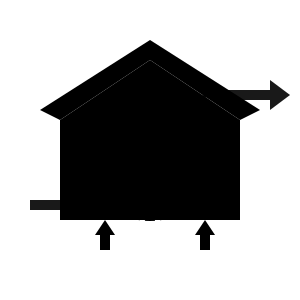
Natural ventilation uses wind pressure and thermal buoyancy to move air through a building without mechanical systems. In Singapore's tropical setting, this involves creating pathways for prevailing breezes to flow through living spaces while allowing hot air to escape through higher openings.
The system relies on strategic placement of windows, vents, and openings to capture the northeast and southwest monsoon winds. When properly designed, temperature differences between indoor and outdoor air create a stack effect, drawing cooler air in at lower levels while pushing warmer air out through upper vents. This continuous air movement can reduce indoor temperatures by 3-5°C compared to sealed spaces.
While cross-ventilation may not completely eliminate the need for cooling systems during peak heat hours, it can substantially reduce reliance on them. Many homeowners in well-designed spaces report using mechanical cooling only 40-60% of the time they previously did.
Success depends on several factors: building orientation, window placement, ceiling height, and surrounding landscape. Homes with proper shading, high ceilings, and unobstructed airflow paths can maintain comfortable conditions during mornings, evenings, and overcast days. Strategic use of fans to enhance natural airflow further extends comfort periods without significant energy consumption.
Position windows on opposite walls to create direct air pathways through rooms. In Singapore, align openings to capture prevailing winds from the northeast (November to March) and southwest (June to September). Windows should be placed at different heights to encourage vertical air movement.
Lower openings on windward sides bring fresh air in, while higher openings on leeward sides allow warm air to exit. Stagger window positions slightly rather than placing them directly opposite to create turbulent mixing, which improves air exchange throughout the space. Consider operable clerestory windows near the ceiling to maximize the stack effect in double-height areas.
A general guideline suggests that ventilation openings should equal 5-10% of the floor area for each room. For a 20 square meter bedroom, this means 1-2 square meters of operable window area. However, this varies based on ceiling height, room depth, and surrounding obstructions.
Inlet openings should be slightly smaller than outlet openings to create positive pressure and improve air velocity. For rooms deeper than 2.5 times their ceiling height, increase opening sizes by 20-30% to compensate for reduced airflow penetration. Professional assessment using computational fluid dynamics can optimize these calculations for specific building configurations.
Higher ceilings significantly improve thermal comfort by allowing hot air to rise away from occupied zones. A ceiling height of 3.5-4 meters provides noticeable benefits compared to standard 2.7-meter heights, as it increases the volume of air available for heat absorption and creates stronger stack effects.
The additional vertical space also accommodates ceiling fans more effectively, as blades can be positioned at optimal heights without compromising headroom. In double-height spaces, the temperature difference between floor and ceiling levels can reach 4-6°C, keeping living areas cooler. Vented ridge lines or roof monitors at the highest points maximize hot air extraction.
Wind catchers and ventilation towers can be highly effective when properly oriented and designed. These vertical structures capture breezes at higher elevations where wind speeds are typically 20-40% greater than at ground level, channeling this air down into living spaces.
In landed properties with adequate roof access, a 2-3 meter tower with directional louvers can increase indoor air velocity by 0.5-1 m/s. The design must account for Singapore's variable wind directions throughout the year. Modern variations incorporate evaporative cooling elements or thermal mass to further reduce incoming air temperature. However, effectiveness diminishes in densely built areas where surrounding structures block wind access.
Light-colored, reflective exterior finishes can reduce heat absorption by 40-60% compared to dark surfaces. White or light gray roof coatings with solar reflectance index (SRI) values above 80 are particularly effective. For walls, materials with low thermal conductivity such as aerated concrete blocks or cavity walls with insulation perform well.
Green roofs with 100-150mm of growing medium provide excellent insulation while cooling through evapotranspiration. Double-skin facades with ventilated air gaps of 150-300mm create thermal buffers that prevent direct heat transfer. Combining reflective surfaces with adequate insulation (minimum R-value of 2.5 for walls, 3.5 for roofs) delivers optimal results in Singapore's intense solar conditions.
Strategic vegetation placement can reduce ambient temperatures around a building by 2-4°C through shade and evapotranspiration. Plant deciduous trees 3-5 meters from west and east-facing walls to block low-angle sun while allowing winter light. Evergreen trees on the south side provide year-round shading.
Vertical gardens on exterior walls act as living insulation, reducing surface temperatures by up to 10°C. Ground covers and lawn areas cool the surrounding air through moisture evaporation. Avoid planting large trees directly in front of windows where they might block breezes. Instead, use them to channel and direct wind toward openings while filtering dust and pollutants from incoming air.
North-facing windows receive minimal direct sun and require only modest overhangs of 600-900mm. South-facing openings benefit from horizontal louvers or fixed overhangs extending 1.2-1.5 meters, which block high-angle sun while permitting indirect light and airflow.
East and west exposures face the most challenging low-angle sun and need vertical fins, adjustable louvers, or external roller screens. Fins spaced at 600mm intervals with 200mm depth provide effective shading while maintaining views. Operable external blinds offer flexibility to adjust based on daily sun paths. Combining multiple shading strategies often yields better results than relying on a single solution.
Install fixed security grilles with bar spacing no wider than 100mm on all ground-floor and accessible openings. These allow full window operation while preventing intrusion. For upper floors, consider lockable casement stays that limit opening angles to 100-150mm, sufficient for ventilation but too narrow for entry.
Louvered security screens combine airflow with protection, featuring angled slats that permit ventilation when closed. Modern options include stainless steel mesh systems with openings fine enough to exclude insects while maintaining 50-60% airflow. Motion-sensor lighting and visible security cameras near openings provide additional deterrence without compromising ventilation capabilities.
Retrofitting is certainly possible, though the extent of improvements depends on existing building structure and layout. Start with low-cost modifications: adding operable vents to upper walls or soffits, installing larger windows where structural walls permit, and removing unnecessary interior partitions to improve airflow paths.
More substantial renovations might include raising ceiling heights in key rooms, adding clerestory windows, or installing roof vents and solar chimneys. Even without major structural changes, improving shading devices, applying reflective roof coatings, and optimizing window operation schedules can reduce indoor temperatures by 2-3°C. A thermal assessment helps identify the most cost-effective interventions for your specific situation.
Natural ventilation systems require minimal maintenance compared to mechanical alternatives. Clean window tracks and hinges quarterly to ensure smooth operation. Inspect and clear any debris from vents, louvers, and wind catchers every three months, especially after heavy storms.
Check security screens and insect meshes monthly for tears or gaps, repairing immediately to maintain effectiveness. Lubricate operable shading devices annually. Trim vegetation around openings twice yearly to prevent airflow obstruction while maintaining shade benefits. Inspect roof vents and flashing for water tightness during the monsoon season. This routine upkeep takes 2-3 hours quarterly and prevents degradation of system performance.
Singapore's high humidity presents challenges for natural ventilation. Maximize air movement to prevent moisture accumulation, as moving air feels cooler and reduces condensation risk. Maintain indoor air velocity above 0.5 m/s using ceiling fans in conjunction with open windows.
Install moisture-resistant materials in bathrooms and kitchens, and ensure these spaces have dedicated exhaust vents to outside. Dehumidifying materials like silica gel or activated charcoal in closets help control localized moisture. During particularly humid periods or heavy rain, close windows on the windward side while keeping leeward openings active to prevent moisture intrusion. Some homeowners use small dehumidifiers in bedrooms overnight while maintaining ventilation in other areas.
Payback periods vary based on intervention type and current energy consumption. Simple modifications like improved shading or additional vents costing $2,000-5,000 typically pay for themselves within 3-5 years through reduced electricity bills. A household spending $300 monthly on cooling can expect savings of 30-50% with comprehensive natural ventilation, translating to $90-150 monthly reduction.
More extensive renovations involving structural changes may cost $15,000-40,000 with payback periods of 7-12 years. However, these improvements also increase property value and comfort beyond mere energy savings. New construction incorporating passive design from the outset adds only 5-8% to building costs while delivering immediate benefits, making it the most cost-effective approach.
Acoustic challenges require balanced solutions that maintain airflow while reducing noise transmission. Install acoustic louvers with sound-absorbing baffles that can reduce noise by 10-15 decibels while allowing 60-70% airflow. Position openings away from direct line-of-sight to noise sources where possible.
Dense vegetation barriers between the property and roads absorb and deflect sound waves. A 3-meter hedge can reduce traffic noise by 5-8 decibels. For severe noise environments, consider a hybrid approach: natural ventilation during quieter periods (late evening, early morning) and mechanical systems with closed windows during peak traffic hours. Acoustic curtains on tracks allow quick adjustment based on conditions without permanent window closure.
The Building Control Act requires approval for structural modifications affecting load-bearing walls or external facades. Adding windows or enlarging existing openings needs submission of plans to the Building and Construction Authority (BCA). Non-structural changes like installing vents or modifying internal partitions typically do not require formal approval.
Condominium and HDB regulations impose additional restrictions on external alterations. Always verify with your Management Corporation or HDB branch before proceeding. Fire safety codes mandate minimum ventilation in habitable rooms: 5% of floor area for natural ventilation or mechanical systems meeting prescribed air change rates. Engage a qualified person (QP) to ensure compliance for significant modifications. Processing time for approved plans typically ranges from 4-8 weeks.
Ceiling fans significantly amplify natural ventilation benefits by increasing air velocity across skin surfaces, creating evaporative cooling. A fan moving air at 1 m/s can make a 28°C room feel like 25°C. Position fans to work with, not against, natural airflow patterns, typically rotating counterclockwise to push air downward.
Install fans with blade spans matching room size: 1.2 meters for rooms up to 12 square meters, 1.4 meters for 12-18 square meters. Mount blades 2.4-2.7 meters above floor level with 300mm clearance from ceilings. DC motor fans consume 60-70% less energy than AC motors while providing variable speed control. Running a 40-watt DC fan costs approximately $7-10 monthly compared to $150-200 for air conditioning the same space.
The most frequent error is placing inlet and outlet openings on the same wall, which creates short-circuiting where air exits immediately without circulating through the space. Another mistake is undersizing openings relative to room volume, restricting airflow regardless of design quality. Avoid positioning furniture or partitions that block air pathways between windows.
Neglecting solar orientation leads to excessive heat gain that overwhelms ventilation benefits. Failing to account for prevailing wind directions results in systems that work poorly during critical hot periods. Inadequate insect screening discourages window use, defeating the entire system. Finally, designing for aesthetics alone without considering functional airflow patterns produces visually appealing but thermally ineffective spaces. Professional assessment during design prevents these costly oversights.
Founded in 2014, Cleanplanpaths emerged from a simple observation: Singapore's tropical climate demands smarter cooling solutions. Our team of 12 certified ventilation specialists and building science consultants has spent nearly a decade researching passive cooling techniques adapted specifically for equatorial environments.
What started as a research project at the National University of Singapore quickly transformed into a practical consultancy. Our founder, a mechanical engineer with 15 years in HVAC systems, noticed that traditional air conditioning accounts for approximately 40% of household electricity consumption in Singapore.
The question was straightforward: could we reduce this dependency through intelligent design? We began analyzing wind patterns across different HDB estates and landed properties in districts like Bukit Timah, Marine Parade, and Tampines. The data revealed significant potential for cross-ventilation strategies that most buildings were simply not utilizing.
Since then, we have completed 287 residential and 43 commercial projects across Singapore, implementing ventilation systems that reduce cooling costs by an average of 35-60%. Each project taught us something new about airflow dynamics, material selection, and the relationship between building orientation and thermal comfort.

We hold certifications from the Building and Construction Authority and maintain partnerships with the Singapore Green Building Council. Our team includes specialists in computational fluid dynamics, building physics, and sustainable architecture.
Every ventilation system we design undergoes computer simulation testing before installation. We model airflow patterns, pressure differentials, and temperature gradients to ensure effectiveness. This approach eliminates guesswork and provides clients with quantifiable performance predictions.
Beyond residential work, we consult for commercial developments, particularly in warehouse and industrial sectors where mechanical cooling costs can exceed S$15,000 monthly. Our solutions have helped businesses reduce energy expenditure while maintaining comfortable working conditions for staff.
Every recommendation stems from measured data and computational analysis. We test assumptions, document results, and refine methods based on actual performance metrics from completed installations.
Singapore's consistent 27-32°C temperatures and 80-90% humidity require specialized approaches. We design systems that work with these conditions rather than fighting against them through energy-intensive methods.
Our focus extends beyond installation day. We provide 5-year performance monitoring for all projects, tracking energy savings and thermal comfort levels to ensure systems continue delivering promised benefits.
We aim to make passive cooling accessible and practical for Singapore properties. Through careful analysis of building characteristics, local wind patterns, and occupant needs, we create ventilation systems that provide genuine alternatives to constant air conditioning. Our goal is reducing energy consumption while maintaining the comfort standards that residents and businesses require in this climate.